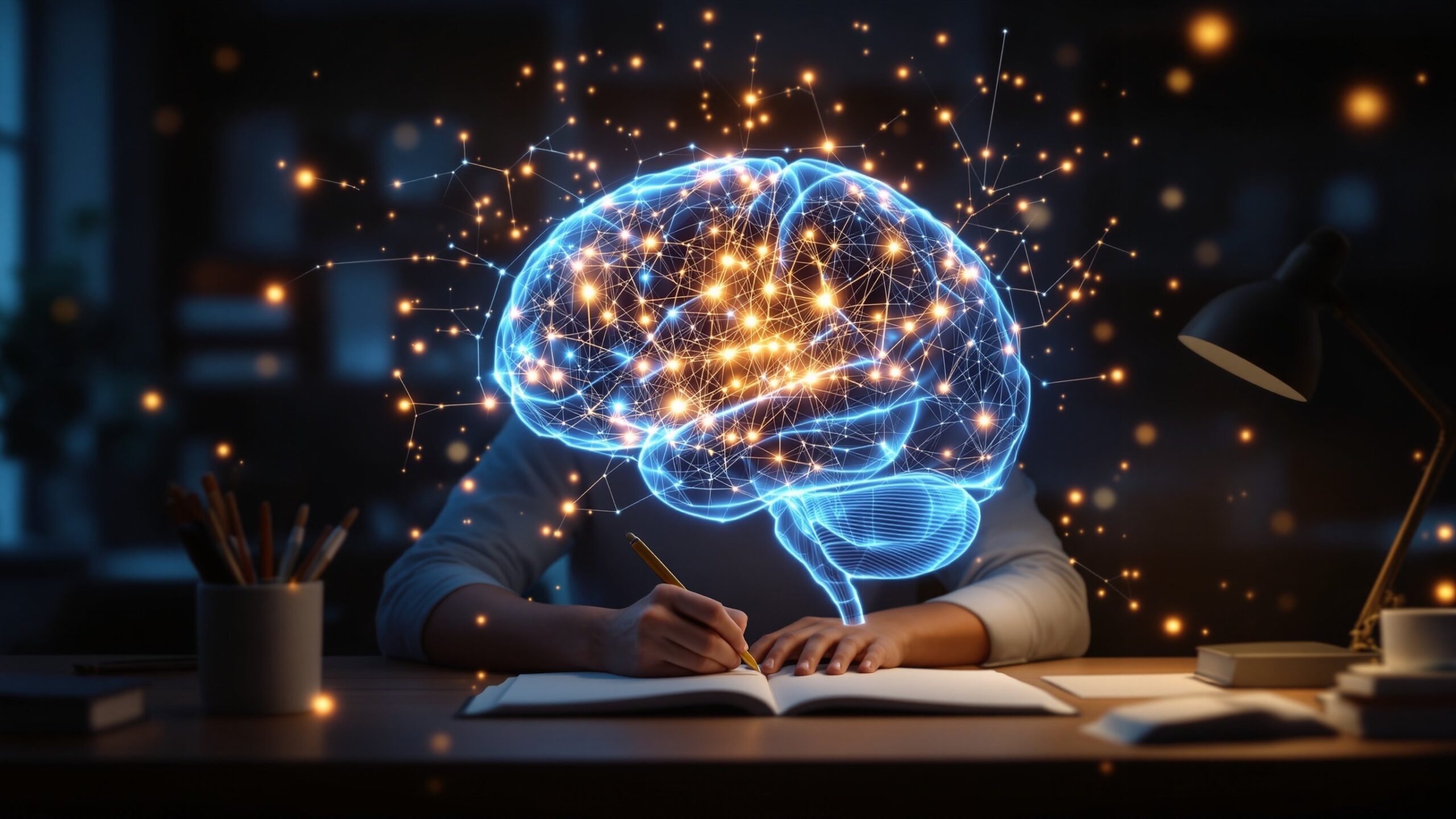
The Brain: A Living Learning Machine
Every time you study, your brain performs one of nature’s most remarkable acts—it changes itself. This process, known as neuroplasticity, is the brain’s ability to rewire and strengthen its neural connections based on experience. Learning is not just about absorbing information; it’s a biological transformation. With each new concept you understand, your brain physically reshapes, forming pathways that make recall and reasoning faster and more efficient over time. When you study a complex topic, billions of neurons fire in intricate patterns across different brain regions. These electric and chemical signals create and reinforce circuits that encode knowledge, habits, and even emotions tied to the experience of learning. What feels like “understanding” is, in truth, a symphony of cellular communication—a constant dialogue between neurons competing and cooperating to make sense of the world. The deeper you dive into a subject, the stronger these connections become, weaving knowledge into your cognitive fabric. The neuroscience of learning shows us that education is not passive—it’s the art of shaping the brain itself.
A: No—AI assists; teachers mentor, motivate, and design experiences.
A: Ask questions, attempt first, use hints sparingly, and reflect after.
A: Choose platforms with clear privacy policies, minimal data collection, and opt-outs.
A: Yes—for feedback on clarity and structure; keep ideas and voice your own.
A: Switch modality (video/text), request a simpler example, or schedule a human check-in.
A: Many tools offer offline lessons that sync when connected.
A: Short daily sessions with spaced review outperform cramming.
A: Over-reliance is a risk; choose hint-first, not answer-first, settings.
A: Yes—target weak areas, simulate exams, and analyze mistakes.
A: Use mastery dashboards; celebrate milestones to stay motivated.
How Neurons Communicate: The Language of the Mind
At the heart of learning lies the neuron, a cell uniquely designed for communication. Each neuron has branching dendrites that receive information and a long axon that transmits it. When you learn something new, neurons communicate through synapses, microscopic gaps where electrical impulses trigger chemical messengers called neurotransmitters.
These neurotransmitters—like dopamine, glutamate, and acetylcholine—carry signals across synapses, forming the basis of memory and cognition. Imagine a dense city where every neuron is a building connected by countless roads of information. The more you revisit a concept, the more traffic flows through specific routes, making them wider and faster. This is how repetition strengthens memory and recall.
When neurons repeatedly fire together, they wire together—a principle known as Hebbian learning. Over time, the brain optimizes these pathways, pruning weak or unused connections to make room for new ones. This efficient reorganization is what allows you to learn a musical instrument, solve complex equations, or master a foreign language.
The Science of Focus: Turning Attention Into Power
Before the brain can learn, it must focus. Attention acts as a cognitive spotlight, directing mental energy toward specific information while filtering out distractions. The prefrontal cortex—often called the brain’s executive center—plays a vital role here, managing working memory, decision-making, and concentration. When you focus intensely on a topic, neural activity in the prefrontal cortex synchronizes with sensory areas that process what you see and hear. This synchronization enhances signal strength, allowing key details to be encoded into short-term memory. However, the brain can only maintain high-focus states for limited periods before mental fatigue sets in. That’s why study techniques like the Pomodoro method—short bursts of focus followed by rest—mirror the brain’s natural rhythm of attention.
Dopamine, the neurotransmitter associated with reward, also influences focus and motivation. When studying feels purposeful or satisfying, dopamine levels rise, reinforcing the desire to continue. This explains why engaging lessons or interactive learning tools can dramatically enhance attention and retention—they literally stimulate your brain’s reward circuitry.
From Short-Term Sparks to Long-Term Memory
Learning begins with encoding—the process of turning sensory input into mental representation. At first, this information is stored in short-term memory, handled mainly by the prefrontal cortex. However, for knowledge to endure, it must travel deeper into the brain’s architecture, particularly to the hippocampus, a seahorse-shaped structure central to memory consolidation.
During this process, temporary neural patterns become stable networks. The hippocampus integrates new data with existing knowledge, connecting facts to form a web of meaning. Repetition and sleep both play crucial roles here. When you revisit material, you reactivate those pathways, reinforcing them; when you sleep, your brain replays and reorganizes them, transferring key memories into the neocortex for long-term storage.
Interestingly, emotion enhances consolidation. Information tied to emotional experiences—like excitement, curiosity, or even stress—activates the amygdala, which flags the memory as important. That’s why emotionally charged learning moments often stick with us for life.
Sleep: The Unsung Hero of Studying
If studying is the act of writing information into your brain, sleep is the editor that polishes and preserves it. Neuroscientists have discovered that during sleep, the brain doesn’t rest—it reorganizes. In the deep stages of non-REM sleep, neural connections formed during the day are replayed and strengthened, while irrelevant data is pruned away. Rapid Eye Movement (REM) sleep, associated with dreaming, plays a different role. It integrates learned material with creative insight, forming associations that spark problem-solving and innovation. Students who sleep well after studying often recall information more clearly and apply it more flexibly than those who pull all-nighters.
Skipping sleep not only hinders consolidation but also disrupts the prefrontal cortex, reducing focus and decision-making ability. The takeaway is clear: sleep is not a luxury—it’s a learning strategy.
Emotion and Learning: The Brain’s Secret Amplifier
Learning is not purely logical; it’s emotional. The brain’s limbic system—particularly the amygdala and hippocampus—links emotion to cognition. When an experience triggers emotion, whether positive or negative, it releases neuromodulators like norepinephrine and dopamine that boost alertness and memory encoding.
This is why emotionally engaging teaching—storytelling, real-world application, or personal relevance—enhances comprehension. Emotional arousal tells the brain, this matters, and neurons respond by strengthening connections. Conversely, chronic stress or fear floods the brain with cortisol, which can interfere with hippocampal function and impair memory.
The best learning environments balance challenge with safety. When curiosity and confidence outweigh anxiety, the brain enters a state of “relaxed alertness,” ideal for creativity and retention.
The Role of Practice and Repetition: Building Neural Highways
Every time you review material or practice a skill, your brain sends repeated electrical impulses through the same neural circuits. Over time, this repetition coats axons—the transmission lines of neurons—with a fatty substance called myelin. Myelin acts like insulation, allowing signals to travel faster and more efficiently.
This process is why musicians, athletes, and language learners improve with practice. Myelination literally builds skill. The more you engage with material, the more your neural highways expand, turning effortful study into automatic mastery. However, repetition without variation can lead to diminishing returns. Studies in cognitive psychology show that interleaved practice—mixing different topics or problem types—produces stronger retention than repetitive drills. By forcing the brain to retrieve information in new contexts, it strengthens flexibility and recall.
Technology and the Brain: The Digital Frontier of Learning
In today’s connected world, learning often happens alongside technology. AI-driven learning systems and adaptive platforms adjust difficulty, pacing, and presentation in real time based on user performance. From a neuroscience perspective, these systems mimic how the brain naturally optimizes learning through feedback.
Virtual reality (VR) and augmented reality (AR) deepen this engagement by activating multiple sensory areas simultaneously. The more senses involved in learning, the stronger and more interconnected the resulting neural pathways. But digital overload poses a challenge—constant multitasking or rapid task-switching can fragment attention and weaken memory encoding.
The key is intentionality: using technology as an enhancer, not a distractor. Well-designed learning tech aligns with cognitive principles, harnessing the brain’s reward systems and spatial memory rather than overwhelming them.
Learning and Age: A Brain That Never Stops Growing
Contrary to old beliefs, the brain remains plastic throughout life. While children’s brains are naturally primed for rapid learning, adults retain the ability to grow new neural connections and even generate new neurons in the hippocampus through a process called neurogenesis. What changes with age is efficiency, not capacity. Adults benefit from richer context and prior knowledge, which helps integrate new information more meaningfully. Regular cognitive challenges—like learning new languages, playing instruments, or problem-solving—stimulate neuroplasticity and protect against cognitive decline.
Even small lifestyle changes—exercise, social connection, and mindfulness—can increase levels of brain-derived neurotrophic factor (BDNF), a protein that nourishes neurons and promotes learning. In essence, a brain in motion stays in motion.
The Power of Reflection and Metacognition
Beyond memorization lies a higher form of learning: metacognition, or “thinking about thinking.” When you reflect on how you learn—what works, what doesn’t—you activate prefrontal regions responsible for planning, self-awareness, and evaluation.
This reflection turns implicit knowledge into explicit strategy. For example, recognizing that you retain more through teaching others or explaining aloud transforms studying into active reinforcement. Metacognition also allows learners to adapt dynamically, selecting the most efficient cognitive tools for each challenge.
Neuroscience confirms that students who engage in reflective learning not only retain more but also develop greater self-efficacy—the belief in their ability to learn. This confidence further amplifies neural plasticity, creating a virtuous cycle of growth.
Stress, Motivation, and the Learning Brain
Stress is a double-edged sword in the learning process. Short bursts of manageable stress, such as studying under mild pressure or facing timed practice tests, can heighten alertness and memory encoding. But chronic stress is toxic, impairing hippocampal neurons and disrupting communication between emotional and cognitive centers.
Motivation acts as the counterbalance. When learners connect purpose to their studies—seeing how knowledge aligns with goals or passions—the brain releases dopamine, reinforcing learning loops. This biochemical reward system fuels persistence and curiosity, two of the most powerful drivers of success. Understanding the interplay between stress, motivation, and emotion is key to creating optimal learning environments, whether in classrooms, workplaces, or self-study.
Why Curiosity Is the Brain’s Superpower
Curiosity is more than interest—it’s the ignition of the brain’s reward system. When you’re curious, your brain releases dopamine even before finding the answer. This anticipatory reward sharpens focus and accelerates learning.
Researchers have found that curiosity not only enhances memory for the subject itself but also improves recall for unrelated information learned at the same time. Essentially, curiosity primes the brain to learn better overall.
This discovery underscores the value of framing study topics as mysteries to be solved or challenges to explore rather than tasks to complete. The more you engage curiosity, the more learning becomes an adventure instead of an obligation.
The Future of Neuroscience in Education
The emerging field of educational neuroscience is merging lab insights with classroom innovation. From brainwave-based attention monitoring to personalized AI learning companions, the boundary between cognitive science and education is rapidly dissolving.
Teachers armed with neuroscience insights are designing lessons that respect attention spans, incorporate retrieval practice, and balance stress and reward. Meanwhile, adaptive software learns alongside the student, continuously optimizing difficulty and timing to match brain readiness. In the near future, neurofeedback devices may allow learners to see their own focus levels in real time, helping them train concentration as deliberately as athletes train muscles. The convergence of neuroscience and technology promises a new era of learning where self-awareness meets scientific precision.
Learning as Braincraft
Learning is not merely a mental activity—it’s braincraft, a living art of shaping your own mind. Every time you study, your brain rewires, strengthens, and refines its networks. The act of learning is an act of creation, transforming experience into structure, curiosity into connection, and effort into understanding.
When you study with focus, rest with intention, and reflect with curiosity, you are not just gathering facts—you are sculpting intelligence. The neuroscience of learning reveals the profound truth that education isn’t something that happens to you—it’s something your brain does with you.
The more we understand that process, the more powerfully and joyfully we can shape the future of human potential.