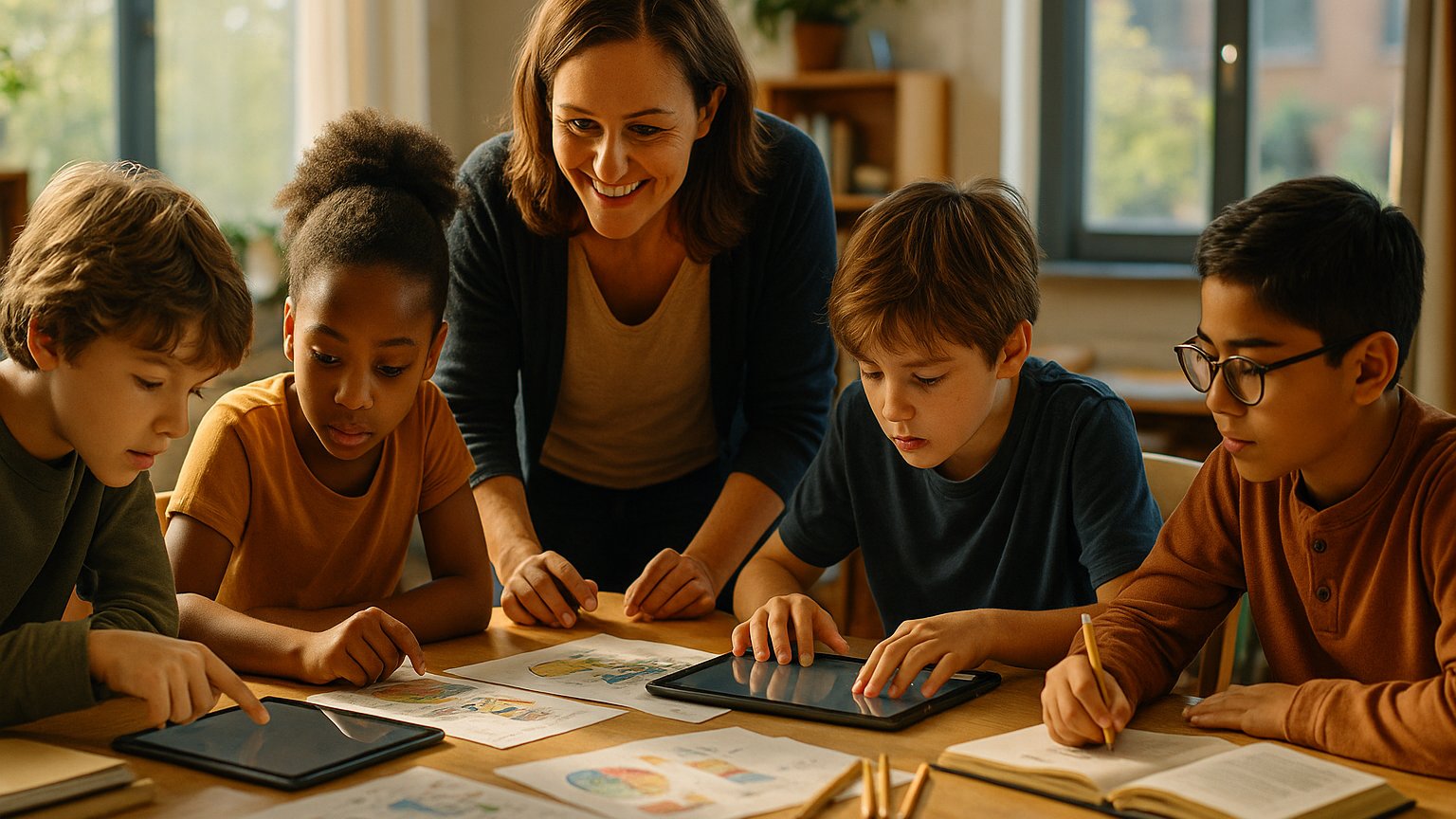
Rethinking Learning: From Absorbing to Building Knowledge
For centuries, education was seen as a one-way street: teachers transmitted facts, and students memorized them. But in the 20th century, a seismic shift occurred. The rise of Constructivism redefined what it means to learn, focusing not on the passive reception of information but on the active construction of understanding. In Constructivist learning environments, students don’t just absorb knowledge—they build it through experience, reflection, and interaction. Teachers become guides, not authorities. Learners explore, question, and connect new ideas to what they already know. This transformation has reshaped everything from classroom design to online education, making learning more engaging, collaborative, and deeply personal.
A: Experiencing the idea first helps you see what the formula means.
A: Great—now we can analyze it and refine your model. That’s learning.
A: Yes—capture examples, connections, and reflections, not just definitions.
A: Use think-time, pair-talk, and written boards before whole-group sharing.
A: On growth and evidence of understanding across drafts, not one-shot tests.
A: Brief mini-lessons target needs that surface during inquiry.
A: Checklists, hints, and models you’ll gradually outgrow.
A: Practice retrieval, explain ideas aloud, and apply them to new cases.
A: Often yes—choice helps you pursue meaningful questions.
A: We’ll rotate roles, use contracts, and check progress with peer feedback.
The Core Philosophy of Constructivism
At its heart, Constructivism rests on a simple yet revolutionary idea: people learn best when they construct meaning based on their experiences. This theory suggests that understanding is not transferred—it’s created. Each learner builds unique mental models shaped by their environment, background, and curiosity.
Constructivism has its roots in the works of Jean Piaget and Lev Vygotsky. Piaget believed learners progress through stages of cognitive development, discovering concepts as they interact with the world. Vygotsky emphasized the social dimension of learning, introducing the Zone of Proximal Development (ZPD)—the sweet spot between what a learner can do alone and what they can achieve with guidance. Together, their ideas established Constructivism as both a psychological and educational framework—one that values process over product, growth over grades, and curiosity over conformity.
From Theory to Classroom: How Constructivism Transforms Teaching
In a Constructivist classroom, learning is inquiry-driven. The teacher is no longer a lecturer but a facilitator of exploration. Instead of starting with answers, lessons begin with questions—authentic, open-ended problems that invite students to experiment, hypothesize, and collaborate.
For example, rather than explaining the laws of motion, a teacher might challenge students to design and test miniature vehicles to explore force and acceleration. Instead of memorizing history dates, learners might analyze primary sources, debate motivations, and reconstruct events to understand their complexity.
Assessment also changes. Traditional tests give way to projects, portfolios, and presentations, allowing students to demonstrate understanding through application and creativity. The classroom itself evolves into a dynamic ecosystem—full of conversation, experimentation, and discovery.
Learning as an Active, Reflective Journey
Constructivism encourages metacognition—the ability to think about one’s own thinking. Learners reflect on what they know, identify gaps, and actively seek understanding. This self-awareness turns education into a journey of inquiry, rather than a checklist of lessons.
Reflection might take the form of journaling after an experiment, discussing challenges during a group project, or analyzing what went wrong during problem-solving. This feedback loop between doing and thinking deepens comprehension and helps knowledge stick. When students construct understanding through trial, dialogue, and reflection, they become more adaptable thinkers. They don’t just learn facts—they learn how to learn.
Collaboration and Social Learning: The Vygotskian Influence
Constructivism recognizes that learning doesn’t happen in isolation—it flourishes through interaction. Vygotsky’s theory of social constructivism asserts that knowledge is co-created through dialogue and shared experiences. In this sense, classrooms become communities of learners, where peer discussion and collaboration are essential tools for meaning-making.
Group projects, peer teaching, and problem-based learning all stem from this social model. When students debate, question, or explain ideas to others, they clarify their own thinking. This process not only builds deeper understanding but also strengthens communication and empathy—skills vital for the modern world.
Technology has expanded this concept globally. Through virtual classrooms, online forums, and collaborative platforms, learners connect with others across cultures, bringing fresh perspectives and new ways of thinking. In essence, digital collaboration is the new frontier of Constructivism.
Constructivism and Modern Educational Technology
In the age of smartphones, virtual labs, and artificial intelligence, Constructivism’s principles are more relevant than ever. Modern learning technologies are built on Constructivist ideas—interactive simulations, gamified lessons, and project-based online courses all mirror the “learn by doing” philosophy. Platforms like interactive coding environments, digital maker spaces, and virtual collaboration tools empower learners to experiment, fail, and iterate safely.
Augmented reality brings history to life. Online discussion boards replicate the peer exchange of ideas once limited to physical classrooms. These technologies shift control from the teacher to the learner, embodying Constructivism’s vision of student-centered education. Whether in a classroom or a virtual space, learners construct knowledge actively—choosing their paths, setting goals, and engaging with ideas that resonate personally.
Real-World Learning: Beyond the Classroom Walls
Constructivism blurs the line between classroom and community. Education becomes experiential, grounded in authentic, real-world contexts. Students might design sustainable gardens, produce documentaries, or analyze local environmental data. These experiences connect theory to practice—learning by doing in the truest sense.
Fieldwork, internships, and service-learning programs are all extensions of Constructivism in action. They show that understanding grows not from listening, but from engaging. By confronting real challenges, students develop transferable skills—critical thinking, collaboration, creativity—that extend beyond school and into life.
This hands-on, inquiry-based approach has also influenced corporate and professional training. Today’s workforce thrives on Constructivist principles—continuous learning, reflection, and adaptation in an ever-changing world.
Assessment Reimagined: Measuring Understanding, Not Memorization
Traditional tests reward memorization, but Constructivism measures comprehension, creativity, and process. Assessments become tools for growth rather than judgment. Instead of asking, “Did you get it right?” teachers ask, “How did you reach your conclusion?”
Performance tasks, reflective essays, and peer assessments replace multiple-choice tests. Students present their understanding through projects, models, experiments, and portfolios—evidence of learning built over time. This shift from performance to progress encourages risk-taking and curiosity. It celebrates learning as a continuous evolution, not a final score.
Teachers as Facilitators: The Art of Guiding, Not Dictating
Constructivism redefines the teacher’s role from knowledge dispenser to mentor and guide. Teachers design environments where students can explore safely, make mistakes, and self-correct. The teacher’s expertise lies in asking powerful questions, offering scaffolds, and connecting concepts across experiences. Instead of lecturing for comprehension, teachers curate experiences that provoke thought and inquiry. They model lifelong learning—demonstrating how curiosity fuels understanding. This approach requires flexibility, empathy, and creativity. A Constructivist teacher doesn’t control learning; they ignite it.
Challenges of Applying Constructivism
Despite its power, Constructivism faces challenges in implementation. Designing lessons that foster discovery while meeting standards can be time-consuming. Assessing qualitative growth in critical thinking or creativity can feel subjective.
Moreover, not all learners thrive in open-ended environments. Some need structure or repetition before embracing independence. The key lies in balance—merging Constructivist principles with clear guidance, feedback, and structure. When properly balanced, Constructivism doesn’t sacrifice rigor for freedom. It builds depth through experience and meaning, guiding learners to genuine mastery.
The Global Impact of Constructivist Education
From Finland’s inquiry-based national curriculum to project-driven schools in the U.S. and Asia, Constructivism has reshaped education worldwide. It has influenced models like Montessori, Reggio Emilia, and International Baccalaureate (IB) programs, all of which promote exploration, reflection, and global understanding. In developing nations, Constructivism helps educators move away from rote memorization toward critical, community-based learning. By empowering students to question, analyze, and innovate, Constructivism builds not only better learners—but more thoughtful citizens. Online, the rise of open-source courses, interactive media, and social learning networks has democratized knowledge, extending Constructivist principles across borders.
Constructivism and Lifelong Learning
Constructivism doesn’t end with formal education—it fuels lifelong growth. Every new skill, hobby, or professional challenge we tackle follows the same pattern: experience, reflection, adjustment, and mastery. Adults, like children, learn best when they can connect new knowledge to existing frameworks.
Whether it’s mastering a musical instrument, learning a language, or adapting to new technology, constructing understanding remains universal. The Constructivist approach reminds us that learning isn’t linear—it’s iterative, dynamic, and personal. It continues long after graduation, empowering individuals to stay curious in a changing world.
The Future: Constructivism in the Age of AI and Global Connectivity
As artificial intelligence and data-driven systems shape the future of education, Constructivism’s relevance only grows. Intelligent tutors and adaptive platforms can personalize learning journeys, allowing students to explore at their own pace while teachers focus on guiding deeper inquiry. Imagine AI systems that analyze student progress, recommend challenges within their Zone of Proximal Development, and facilitate global collaboration across continents. These technologies make Constructivism scalable—turning classrooms into connected ecosystems of inquiry and innovation. In this future, Constructivism serves as the human core of education—ensuring technology enhances learning rather than replacing it.
Why Constructivism Endures
Constructivism endures because it mirrors life itself. We don’t learn by memorizing rules—we learn by living them, by testing ideas, by connecting meaning to experience. This approach honors curiosity, creativity, and diversity—qualities that define not just good learners, but good humans. It’s the bridge between theory and reality, between knowledge and wisdom. It reminds us that education is not about filling minds—it’s about awakening them.
Final Thoughts
Constructivism revolutionized education by turning students into creators of knowledge rather than consumers of information. It challenged teachers to become designers of discovery. And it reshaped schools into living laboratories where curiosity, collaboration, and reflection thrive.
In today’s interconnected, ever-changing world, Constructivism isn’t just a teaching method—it’s a mindset. One that empowers learners to adapt, innovate, and imagine possibilities beyond the page.
The modern classroom—physical or virtual—echoes its principles everywhere. When students build their own understanding, they don’t just learn—they transform. And that is the ultimate purpose of education.
How To Put The Idea Into Practice
The practical value of constructivism appears when it changes what a learner does next. For a teacher designing lessons where students build understanding through experience and reflection, the goal is not to admire the concept from a distance. The goal is to turn it into a small, observable learning move that can be practiced, checked, and improved. That may mean changing the study routine, redesigning a lesson activity, choosing a better tool, or giving feedback that helps the learner try again with more clarity.
A useful starting point is asking students to investigate, explain, discuss, revise, and connect new ideas to prior knowledge. This keeps the topic connected to action instead of leaving it as a broad education idea. The activity does not need to be complicated. It needs to make the learner think, recall, compare, explain, decide, revise, or apply something in a way that can be seen. When the task creates visible evidence of understanding, teachers and learners can respond before confusion becomes permanent.
This matters across project-based learning, science lessons, discussion courses, simulations, and online collaborative activities. Each setting has different constraints, but the same design question remains: what does the learner need to do with the idea after the explanation ends? If the answer is unclear, the lesson usually needs a stronger example, a shorter practice step, or feedback that points to the next improvement.
What To Watch During Review
The main risk is leaving students to explore without enough structure, examples, or feedback. That risk shows up when a lesson sounds convincing but does not improve recall, judgment, confidence, or performance. A strong review looks at learner behavior rather than surface polish. Did learners remember the point later? Did they make better choices? Did they ask clearer questions? Did they correct the same mistake less often? Those signs matter more than whether the topic felt familiar during the first pass.
Review also protects the article or course from becoming too thin. If the content only defines the term, learners may leave with vocabulary but no usable method. Better learning content explains the idea, shows why it matters, gives a realistic example, names a common mistake, and offers a way to test understanding. That fuller path helps the reader connect the topic to real study, teaching, training, or decision-making.
The final check is transfer. A learner has gained something meaningful when the idea can travel beyond the screen. They can use it in a new class, a work task, a study session, a planning meeting, or a conversation with another learner. When constructivism supports that kind of transfer, it becomes more than an education term. It becomes part of how learning improves.
That is the standard worth using during revision: clear enough to understand, specific enough to practice, and useful enough to carry into the next learning moment.